Podiatry billing that proves every visit. Foot care, nail debridement, wound care, injections and diabetic shoes, each billed to its payer’s rules.
The AI drafts the codes from the note and your podiatrist approves them. From there our billing team takes the claim to the deposit.
- Practices of 1–20 podiatrists
- Works inside your EHR
- Commercial, Medicare, Medicaid
What we fix
What podiatry practices miss. We bill all of it.
Every claim, start to finish
From your note to your bank. Every step on the record.
You see who touched each claim, and when.
Your dashboard
Every number, live. Down to each visit.
Collections, denials, days to payment and open AR.
Try the live demo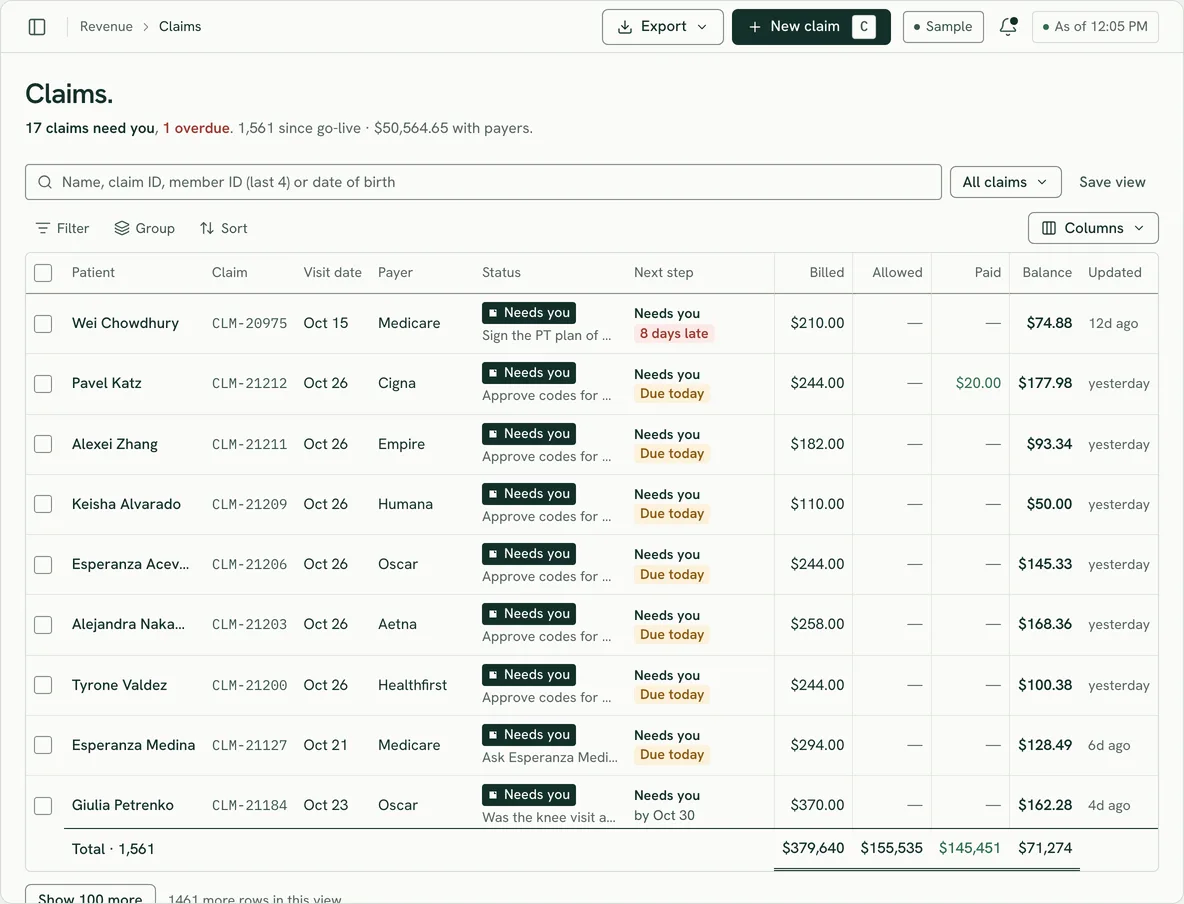
Denials and appeals
We fight every denial. Even the $58 ones.
In podiatry, the usual ones are routine foot care rules, frequency limits, and bundled procedures.
How we fight denials- 01Fix and resendSame claim
- 02Appeal with the recordsBilling manager signs
- 03Chase claims with no replyStatus, then a call
- 04Check what was paidAgainst your contract
Start with a free podiatry audit.
Free · no obligation · no patient data in the form.
Start the audit- Sign a short BAAWe email it to you.
- Upload two reports12 months of 835s and your AR aging.
- Get your practice profileDenials ranked by dollars, walked through on a call.
The rules we bill by
Routine foot care is covered only when the note proves it.
These are the Medicare rules our team bills by. Medicare Advantage plans usually follow them; commercial plans vary.
-
Q7 · Q8 · Q9
Class findings decide coverage
Foot care for a patient with diabetes or poor circulation is covered when the exam shows one Class A finding (Q7), two Class B (Q8), or one Class B and two Class C (Q9).
-
11720 · 11721
Nail debridement, by count
11720 covers one to five nails and 11721 six or more. Trimming of dystrophic nails is coded separately (G0127).
-
11055–11057
Paring corns and calluses
One lesion is 11055, two to four is 11056, and five or more is 11057. Each lesion needs a reason in the note.
-
Treating doctor
Who manages the condition
When coverage rests on a systemic condition, some claims also need the name of the doctor treating it and when they last saw the patient.
Sources: Wellpoint Federal routine foot care billing article (A57759) · Medicare Benefit Policy Manual, ch. 15, §290. Rules as of November 2026; commercial plans and Medicaid set their own.
Questions owners ask.
Do you bill wound care and surgery too?
Yes. Debridement, injections, in-office procedures and surgery are billed with the prior authorizations and global periods each one needs.
How do you handle routine foot care for Medicare patients?
We check the note for the qualifying condition and class findings, add the right Q modifier, and set up an ABN when a visit isn’t covered.
Do you bill diabetic shoes and inserts?
Yes. We make sure the certifying doctor’s statement, the prescription and the fitting are on file before the claim goes out.
What will this cost us?
3.5–5.5% of collections · annual agreement · 45-day opt-out. Payers pay you directly, into your bank account. We invoice our fee monthly from posted collections. See pricing.
How long does switching take?
About 30–45 days, with a parallel run before go-live. Your EHR, bank account and payer contracts stay the same. See how switching works.
What if it isn’t working for us?
If it isn’t working in your first 45 days, you can leave, no questions asked. After that it’s an annual agreement, which sets out the notice and how your files come back to you.
Every foot care visit, billed right. Let’s look at yours.
3.5–5.5% of collections · annual agreement · 45-day opt-out
Rather start with your numbers? Get a free billing audit.